Islam West Africa Collection (IWAC)

io.github.fmadorePublished by GitHub account fmadorev6.2.0Updated Nov 21, 2026

Read-only access to the Islam West Africa Collection via Hugging Face datasets.

VerifiedStreamable HTTPWeb executableKnowledge & MemoryData & AnalyticsMedia & Design

Overview

AI-generated overview

Read-only access to the Islam West Africa Collection: search and fetch archived press, publications, references, images and audiovisual items, plus corpus…

What you can do
  • Search across all subsets or per subset (articles, publications, references, documents, audiovisual, photographs) and fetch full text or excerpts by id
  • Semantic search over articles, publications, references and photographs, ranked locally with an embedding model
  • Look up the authority index of persons, places, organisations, events and subjects, and list subjects, locations and persons by frequency
  • Get collection, newspaper and country statistics, temporal distributions including Hijri months, and AI sentiment labels with model agreement
  • Run aggregates: topic, field, place and lexical distributions, co-occurrence, embedding maps and nearest-neighbour items
  • Build selections in a workbench…
When to use it
Useful for research or writing about Islam and Muslim communities in Benin, Burkina Faso, Côte d'Ivoire, Niger, Nigeria and Togo, where an assistant should search French-language sources, cite canonical archive links and report counts with coverage caveats.
Requirements
Either the hosted endpoint or a local desktop bundle for Windows or macOS; Claude Desktop supplies the Node.js runtime, and self-hosting needs Node.js 24 or newer. First use downloads about 265 MB of parquet data from Hugging Face into a local cache; semantic search downloads a further ~350 MB model and needs Windows x64/ARM64 or Apple-silicon macOS. Optional private full text needs a Hugging Face token with read access, set in settings or via IWAC_HF_TOKEN with IWAC_PRIVATE_DATASET=true.
Before you install
Read-only, but the optional private mode requires a sensitive Hugging Face token (IWAC_HF_TOKEN or the settings field) that should never be pasted into a chat; enabling private mode on a shared HTTP instance exposes full text to everyone who can query it, so HTTP mode refuses to start without IWAC_ALLOW_PRIVATE_HTTP=true. Semantic search runs locally and sends no query out, but data is downloaded from Hugging Face. AI sentiment labels, topic assignments and similarity scores are model outputs…

Installation

In SourceWeft

  1. Open Islam West Africa Collection (IWAC) in the dashboard and add it to a workspace.
  2. Enable the server for the chats that should use its tools.

Web executable via Streamable HTTP. Remote servers run from the web runtime once configured in a workspace.

Use with an agent

Paste this prompt into Claude Code, Codex, Cursor or another agent — or into SourceWeft chat. The agent reads this server's install guide, shows you its publisher, endpoint and sign-in, and adds it to your client once you agree. Keys never go into a command.

Read https://sourceweft.com/mcp/io.github.fmadore%2Fiwac-mcp-server/install.md and connect the MCP server it describes to my client. Before changing any config, show me its publisher, endpoint and sign-in method and wait for my OK. Never put an API key in a command or in a file I would commit; ask me where it should come from.

Read the install guide the agent follows

Other MCP clients

Add this to your client's mcpServers config.

{
  "mcpServers": {
    "islam-west-africa-collection-iwac": {
      "type": "http",
      "url": "https://islam.zmo.de/mcp/"
    }
  }
}

README

IWAC MCP Server

[CI] [Release build] [Latest release] [MCP Registry] [License: MIT] [DOI]

A read-only Model Context Protocol server for the Islam West Africa Collection (IWAC). Ships as a one-click Desktop Extension (.mcpb) for Claude Desktop, backed by the IWAC Hugging Face dataset. Also available as a hosted endpoint at https://islam.zmo.de/mcp/ for ChatGPT and other MCP clients — see docs/connecting.md for the full connection walkthrough (Claude Desktop and ChatGPT).

Install

Each release ships a server bundle for your operating system plus a research-skill .zip. The .mcpb gives Claude the data and tools; the .zip adds a research skill that teaches Claude how to use them. Install the server first, then install the skill too — strongly recommended for getting the most out of the tools: it makes Claude search and synthesize far more efficiently, with fewer wasted queries.

1. The MCP server — pick the bundle for your OS

Your OSDownload
Windows (Intel/AMD or Snapdragon)iwac-mcp-server-windows.mcpb
macOS (Apple Silicon or Intel)iwac-mcp-server-macos.mcpb
  1. Download the latest bundle for your OS using the links above.
  2. Double-click the file. Claude Desktop shows an install dialog — click Install.
  3. On first use the server downloads ~265 MB of parquet data from Hugging Face into ~/.iwac-mcp/cache/ (override in the extension settings).

The bundle contains the server and DuckDB binaries for your OS (x64 and arm64). Claude Desktop supplies the Node.js runtime, so no separate Node.js or Python installation is needed. We publish desktop bundles for Windows and macOS.

Extension settings and updates

Open Settings → Extensions → Islam West Africa Collection (IWAC) in Claude Desktop to configure these options:

FeatureCredentialsSettings
Public keyword search, filters, statistics, and item detailsNoneDefault.
Semantic searchNoneOn by default (Semantic search). The first semantic search downloads the query model once (~350 MB); turn the setting off to skip it.
Private full textHugging Face token authorized to read the private datasetEnable Use private full dataset and enter Hugging Face token (private dataset only).

Semantic search runs EmbeddingGemma 2, the model the corpus vectors were made with, on your own machine: no API key, and no query leaves your computer. It needs Windows (x64 or ARM64, with the Microsoft Visual C++ 2015-2022 Redistributable that most PCs already have) or an Apple-silicon Mac; on an Intel Mac the semantic tools report that they cannot run, and everything else works. The shared hosted endpoint serves public data.

Updating: download and open the latest bundle for your OS to update the extension. If the Hugging Face fields are missing, your installed extension may predate v3.6.0. After updating, review the settings, save any changes, and restart Claude Desktop.

Optional private full-text access

Public data remains the default and needs no token. In the desktop extension, enable Use private full dataset, enter the Hugging Face token (private dataset only), save the settings, and restart. Use a fine-grained token with read access to fmadore/islam-west-africa-collection-full. The token field is marked sensitive. Never paste your token into a chat or commit it.

Other local launchers can set IWAC_PRIVATE_DATASET=true and provide IWAC_HF_TOKEN (or HF_TOKEN). A token alone does not enable private mode; public downloads do not send it. No new dependency or account system is needed.

Private files use a separate private-full/ subdirectory of IWAC_CACHE_DIR (default: ~/.iwac-mcp/cache). Restart after changing modes. Missing tokens and private HTTP 401/403/404 errors fail without cache fallback. Network outages may use that mode's cache. Explicit IWAC_OFFLINE=true uses downloaded files without authentication; removing a token does not erase private files.

Keep the shared hosted endpoint public. This setting applies to the whole instance: everyone who can query a private instance can access its full text. HTTP mode therefore refuses to start in private mode unless IWAC_ALLOW_PRIVATE_HTTP=true is also set, and both transports log which dataset they serve at startup.

2. The research skill — iwac-mcp-skill.zip (strongly recommended)

The iwac-mcp skill wraps the raw tools in a structured research workflow: a five-phase methodology, francophone search strategy, source attribution with confidence grading, and bias/coverage caveats. It makes the server far more efficient to use — Claude picks the right tool and search terms on the first pass (fewer wasted queries), searches French sources properly, and returns a cited synthesis instead of a raw tool dump. You can run the tools without it, but you'll get more out of every query with it installed.

Download the latest iwac-mcp-skill.zip, then:

  • Claude Desktop — open Customize → Skills → + → Create skill → Upload a skill and select the zip. (Or unzip it into ~/.claude/skills/ and restart Claude Desktop.)

  • Claude Code — unzip it into your skills directory; Claude Code discovers it live, no restart needed:

    bash
    # macOS / Linuxunzip iwac-mcp-skill.zip -d ~/.claude/skills/
    powershell
    # Windows (PowerShell)Expand-Archive iwac-mcp-skill.zip -DestinationPath $HOME\.claude\skills\

    Both land the skill at ~/.claude/skills/iwac-mcp/. The repository source of truth is .agents/skills/iwac-mcp/; keep project-local copies there rather than duplicating the same skill under .claude/.

    Installing it this way is still worth doing: an installed skill is matched against your question automatically, before any tool is called.

The server also serves the skill (skill://)

Every build embeds the research skill, including the Docker image, and serves it through the MCP SDK's implementation of the Skills extension (SEP-2640, io.modelcontextprotocol/skills). Clients supporting it discover the skill through skills/list and skills/get, browse it with resources/directory/read, and check every file they read against the manifest's SHA-256 digests. Clients without the extension see every file in resources/list, each with a title and a one-line summary, and read it with ordinary resources/read:

ResourceContent
skill://iwac-mcp/SKILL.mdResearch workflow
skill://iwac-mcp/references/…Four reference files, read on demand
skill://iwac-mcpThe skill's directory, for resources/directory/read

The bare skill://iwac-mcp URI is a directory, no longer the JSON catalogue that releases up to v4.1.0 served there; skills/list carries the same sizes and digests. Skill content is a build-time snapshot; editing the source requires a rebuild. The release zip remains available for clients that install skills locally. Remote clients can read the same workflow without downloading a release artifact.

What it gives Claude

39 read-only tools across seven IWAC subsets, none of which needs an API key. The 4 semantic_search_* tools can be turned off; they rank with EmbeddingGemma 2 run locally (see mcpb/README.md). All keyword and filter matching is accent- and case-insensitive. The unified search/fetch pair, the stats tools, the aggregates, list_periodicals, and get_sentiment_distribution also return MCP structured content (outputSchema + structuredContent), which the ChatGPT connector contract requires.

The tool contract, as of v5.0.0:

  • One keyword rule. Every search and aggregate requires every word of a keyword, in any order; a "quoted phrase" must occur as written, and keyword_mode: "literal" keeps the single-substring match of earlier releases. A one-word keyword is unchanged.
  • Strict arguments. An unknown argument name is an error, never an unfiltered search; strings are bounded at 2,000 characters.
  • Coded errors. Every error carries a stable code (invalid_argument, not_found, unavailable, data_error) beside its message.
  • Self-explaining empty results. A filtered list that matches nothing says so (hint), and the article, publication and reference searches suggest close stored subject and newspaper values (did_you_mean). Pages stop early at ~40,000 characters (response_limited, with an exact next_offset).
  • Linked exports. explore_corpus with link: true returns one iwac://export/… resource link holding a whole selection (up to 5,000 items) as a manifest, CSL-JSON or BibTeX file, instead of 50-item pages in the conversation.
  • Compact provenance. The model reads the snapshot id, revision, access mode and subsets; file identities stay in _meta and iwac://datasets/{subset}.
  • Profiles. IWAC_TOOL_PROFILE=core|analysis|search serves a smaller tool surface for hosts that pay for every definition on every turn; the instructions name only the tools a profile registers.
GroupTools
Cross-subsetsearch, fetch, explore_corpus
Articlessearch_articles, get_article, semantic_search_articles
Sentimentsearch_by_sentiment, get_sentiment_distribution
Indexsearch_index, get_index_entry, list_subjects, list_locations, list_persons
Statsget_collection_stats, get_newspaper_stats, get_country_comparison, get_temporal_distribution
Aggregatesget_topic_distribution, get_field_distribution, get_cooccurrence, get_lexical_metrics, get_place_distribution, get_semantic_map, get_similar_items
Publicationssearch_publications, list_periodicals, get_publication_fulltext, semantic_search_publications
Referencessearch_references, get_reference, semantic_search_references
Imagessearch_images, get_image, semantic_search_images
Othersearch_documents, get_document, search_audiovisual, list_audiovisual, get_audiovisual

The aggregates answer questions about a whole set rather than returning its items: how it spreads across the 30 precomputed LDA topics, which subjects, places or bylines dominate it, what gets discussed alongside what, how its prose reads, where on a map it points, how it lays out in embedding space, and what a given item's nearest neighbours are. Fourteen tools in all (the stats family, these aggregates, list_periodicals, get_sentiment_distribution and explore_corpus) declare an MCP App view, so in Claude they render as interactive charts rather than JSON.

get_temporal_distribution also reads the Islamic calendar. With granularity="lunar_month" it pools every year into the twelve lunar months — the one bucket a Gregorian axis structurally cannot produce, because the Hijri year drifts ~11 days annually and so smears each observance across all twelve Gregorian months. Over the 16,579 fully-dated articles the archive's rhythm is plain: Ramadan +73%, Dhu al-Hijja +68% (hajj and Tabaski) and Shawwal +42% (Korité) against an even split, while Rabi' I (Maouloud) sits flat. search_articles and search_publications take hijri_month (1–12 or a name in either transliteration) and hijri_year to read the items behind a peak. The lunar dates are precomputed in the dataset pipeline with the Umm al-Qura tables, the same converter the on-this-day block on islam.zmo.de uses, so the two never disagree; items dated only to a year or month have no lunar date and are reported in imprecise_date_count rather than plotted.

The four full-text tools (get_article, get_document, get_publication_fulltext and get_audiovisual) optionally take a keyword to return ~2000-char excerpts around each match, so Claude reads just the relevant passages of a long article, archival document, periodical issue or transcription instead of the whole text. When the whole text is what you want, they serve it in 25,000-character parts: each part says where the next one starts (next_offset), and passing that back as offset reads on to the end.

Every result object includes a url field pointing at the canonical IWAC record, e.g. https://islam.zmo.de/s/afrique_ouest/item/28576.

About the collection

IWAC is a digital archive focused on Islam and Muslims in West Africa:

  • 16,700+ newspaper articles from Benin, Burkina Faso, Côte d'Ivoire, Niger, and Togo, 1961 to the present (mostly French), each with an AI abstract. The public dataset carries full OCR for the ~45% whose text is public on islam.zmo.de; get_collection_stats reports the live ratio.
  • AI sentiment analysis (polarity / centrality / subjectivity) for the articles, scored independently by six models: gpt-5-6-luna, mistral-small-2603, deepseek-v4-flash-0731, gemma-4-31b-it, qwen3-8-27b and claude-haiku-5-5. Haiku is the default since 6.0.0 (the one the inline columns report), because it alone has read the newest arrivals. All six agree on polarity for only ~30% of the articles they all scored, so get_sentiment_distribution(model="all") is the honest way to quote a figure. They do not all cover the same articles either: four score 12,298, qwen3-8-27b 12,098, and claude-haiku-5-5 16,617, including ~4,400 recent arrivals it alone has read. So each model reports its own coverage. model="consensus" returns the panel's precomputed majority (not a seventh model), and search_by_sentiment(disputed=…) reads the articles it split on
  • 5,000+ authority records (persons, organisations, places, events, subjects)
  • 1,500+ Islamic publications (periodical issues, books), most with full OCR
  • 860+ academic references, half with abstracts
  • 1,800+ audiovisual items: francophone web video from Burkina Faso, Togo and Benin (harvested from public channels, still growing, searchable by channel and reachable through a watch URL), plus 47 deposited Nigerian Hausa/Arabic recordings with files
  • 26 archival documents and 30 fieldwork photographs

Research workbench

explore_corpus connects selections to sources, keyword contexts, coverage heatmaps, comparisons, publication-country/mentioned-place matrices, and pageable manifest, CSL-JSON and BibTeX exports. iwac://datasets/{subset} resources expose current columns, field availability and dataset provenance. Temporal charts support normalized shares with explicit denominators. Sentiment comparisons accept the same selection filters and a chosen pair of models, with Cohen’s kappa and quadratic weighted kappa on explicitly reported populations. Exact chart selections, source reading, Back navigation and provenance exports are shared across the app. See the workbench guide for examples, interpretation limits, cache behavior and local embedding migration.

On supported MCP Apps hosts, Fullscreen expands the view, and a compact summary of the current selection is shared automatically with the assistant. Ask about this selection sends an explicit question with that selection's snapshot; automatic updates do not start a conversation turn. The summary carries bounded filters, counts, source IDs and provenance, with omissions marked; full source text still requires retrieval. Controls depend on the host's advertised capabilities. See the interaction contract.

Architecture

  • Data: parquet files from the IWAC Hugging Face dataset are lazily downloaded per subset (articles, publications, documents, audiovisual, images, index, references) into a local cache and queried through DuckDB views. A long-running server re-checks each subset daily (IWAC_REFRESH_HOURS) and swaps in a newer revision without a restart. Each request pins its files; old generations are retained for other readers and reproducibility. All SQL is parameterised; matching is accent/case-insensitive.
  • Transports: stdio (the default — what the Claude Desktop .mcpb uses), and a stateless Streamable-HTTP mode (node server/index.js --http) behind a bearer token, which the Docker image runs for the hosted https://islam.zmo.de/mcp/ endpoint.
  • Docker: every release publishes ghcr.io/fmadore/iwac-mcp-server for self-hosting the HTTP endpoint — see mcpb/README.md for the required env vars and token setup.
  • Provenance: from v5.0.0 the release workflow attests the build provenance (SLSA, through GitHub's Sigstore) of both desktop bundles, the skill zip, server.json and the image. Verify a download with gh attestation verify iwac-mcp-server-windows.mcpb -R fmadore/iwac-mcp-server, or the image with gh attestation verify oci://ghcr.io/fmadore/iwac-mcp-server:5.0.0 -R fmadore/iwac-mcp-server.

Develop

This implementation requires Node.js 24 or newer for both the build and server runtime. Node.js 20 is end of life. Desktop hosts with an older embedded runtime must be upgraded before installing the next bundle; the manifest rejects incompatible runtimes.

The bundle lives under mcpb/. See mcpb/README.md for the build / pack workflow.

bash
cd mcpbnpm cinpm run install-bindings   # fetch the 4 macOS/Windows DuckDB binariesnpm run typecheck   # tsc --noEmitnpm run lint        # biome (linter only)npm run build       # esbuild -> single server/index.jsnpm test            # unit, fixture, app, skills, HTTP and token-budget testsnpm run test:browser # Chromium app behavior (install browser first)npm run test:live   # full smoke test against the real HF dataset (~265 MB)

CI runs the version check, typecheck, lint, build, unit tests, and the offline fixture + HTTP round-trip tests on every push to main and every pull request; the live smoke test runs weekly (its pinned counts are the dataset-drift alarm). Releases: push a v* tag — the release workflow re-runs the full test suite, checks that the version is unpublished, packs and validates desktop bundles on macOS/Windows, and smoke-tests the Docker image before publication. The publish job uses those tested artifacts. Existing releases and registry versions cannot be overwritten; use a new version for a new release.

Roadmap

See TODO.md. Near-term: submit to the Anthropic extension directory and sign the bundle with a production code-signing cert.

How to cite

Machine-readable metadata lives in CITATION.cff — GitHub's Cite this repository button (sidebar) renders it as APA or BibTeX with the current version filled in. In text:

Madore, F. (2026). IWAC MCP Server (Version 6.2.0) [Computer software]. Zenodo. https://doi.org/10.5281/zenodo.21805837

bibtex
@software{madore_iwac_mcp_server,  author    = {Madore, Frédérick},  title     = {{IWAC MCP Server}},  year      = {2026},  version   = {6.2.0},  publisher = {Zenodo},  doi       = {10.5281/zenodo.21805837},  url       = {https://github.com/fmadore/iwac-mcp-server},  license   = {MIT}}

That DOI is the concept DOI — it always resolves to the newest release, so it stays correct as versions come and go. If you need to cite the exact version you ran, take the per-version DOI from the Zenodo record.

If the software helped you reach a finding, please cite the collection itself as well — that is where the archival work lives.

License

MIT

Related
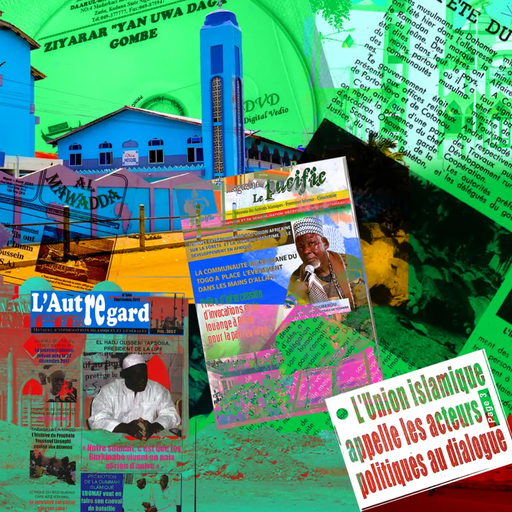
Source: README.md at commit ac0f6c7

Tools

39

fetch

Fetch IWAC item

Retrieve the full text and metadata of one IWAC item by an id returned from `search` (format '<category>:<number>', e.g. 'articles:28576'). Returns {id, title, text, url, metadata}: `text` is the item's OCR / abstract / transcription / description, `url` is the canonical islam.zmo.de link to cite, and `metadata` holds the remaining fields (author, date, country, newspaper, AI sentiment, …). Categories: articles, publications, references, documents, index, audiovisual, images.

Parametersidrequired

explore_corpus

Research workbench

Selection workbench: items, concordance, coverage, compare (requires comparison), attention, aliases, or paginated manifest/CSL-JSON/BibTeX exports. Exact filters intersect. limit/offset also page compare/coverage/attention cells. Coverage measures archive availability. Exports identify this page and dataset snapshot; compare snapshot IDs across pages. Schema discovery: iwac://datasets/{subset}.

Parameterslinkmodelimitoffsetsubsetselectioncomparison

search_articles

Search newspaper articles

Search IWAC newspaper articles by keyword (title + OCR + AI abstracts, French and English), country, newspaper, subject, and date range. The press is French; English terms match only the English abstract. Matching is accent- and case-insensitive.

Parametersexactlimitoffsetcountrydate_tokeywordsubjectdate_fromnewspaperhijri_yearhijri_monthkeyword_mode+2 more

get_article

Get article details

Get one article (by id): full metadata, the AI abstract (description_ai), AI sentiment, and OCR text, in 25k-char parts (follow `next_offset`). Pass a `keyword` to get ~2000-char excerpts around each match instead.

Parametersoffsetkeywordarticle_idrequiredmax_excerptscontext_chars

semantic_search_articles

Semantic search for articles

Semantic search over article title + full text, including articles whose OCR is not public. Query in any language. Runs the corpus model, EmbeddingGemma 2, locally with no API key (first use downloads ~350 MB). similarity_score only ranks within one query.

Parameterslimitqueryrequiredcountrydate_todate_fromnewspaper

search_by_sentiment

Filter articles by AI sentiment

Filter articles by claude-haiku-5-5 sentiment labels (accent/case-insensitive exact match). One model's reading, not a consensus — 5 other models scored the same articles and often disagree; get_sentiment_distribution with model:"all" shows by how much. `subjectivity` is much the weakest of the three scales, so a set selected on it is a lead to read, not a finding.

Parameterslimitoffsetcountrysubjectdisputedpolaritycentralitysubjectivity

get_sentiment_distribution

Aggregate AI sentiment

Aggregate AI labels over a shared selection. model:"all" compares independent annotators and their coverage; model:"consensus" reads the stored panel majority. compare_models and agreement_field give pairwise Cohen's kappa and quadratic weighted kappa, with explicit denominators. Labels are interpretations, not ground truth; subjectivity is weak evidence, and results carry its caveat.

Parametersexactmodelcountrydate_tokeywordsubjectdate_fromnewspaperhijri_yearhijri_monthkeyword_modecompare_models+2 more

search_index

Search authority index

Search the IWAC authority index (persons, places, organisations, events, subjects) by name. Accent/case-insensitive.

Parameterslimitoffsetkeywordrequiredindex_type

get_index_entry

Get index entry details

Get full details of an index entry by id (raw dataset columns, French names — Titre, Prénom, Coordonnées…).

Parametersentry_idrequired

list_subjects

List sujets from the index

List sujets from the IWAC index, sorted by frequency (most-referenced first).

Parameterslimitoffset

list_locations

List lieux from the index

List lieux from the IWAC index, sorted by frequency (most-referenced first). The optional 'country' filter selects entries that APPEAR IN records from that country (mentioned-in, not located-in), ranked by collection-wide 'frequency' — so foreign and cross-border entries can appear. Nigeria reaches only the few entries its references mention (index frequency counts articles, publications and references; no article is Nigerian).

Parameterslimitoffsetcountry

list_persons

List personnes from the index

List personnes from the IWAC index, sorted by frequency (most-referenced first). The optional 'country' filter selects entries that APPEAR IN records from that country (mentioned-in, not located-in), ranked by collection-wide 'frequency' — so foreign and cross-border entries can appear. Nigeria reaches only the few entries its references mention (index frequency counts articles, publications and references; no article is Nigerian).

Parameterslimitoffsetcountry

get_collection_stats

Collection statistics

Overall statistics for every IWAC subset, including `fulltext_coverage` — how many items in each subset actually carry searchable full text in this dataset: a keyword count is a full-text census only within that coverage.

Takes no parameters.

get_newspaper_stats

Newspaper statistics

Per-newspaper article counts and date ranges.

Parameterscountry

get_country_comparison

Compare countries

Compare article counts, newspaper counts, date ranges, and claude-haiku-5-5 polarity across countries.

Takes no parameters.

get_temporal_distribution

Coverage over time

Counts by Gregorian or Hijri year/month, or pooled lunar month. Group by country/newspaper. Partial dates and missing lunar dates are disclosed. normalize_by returns numerator counts and per-bucket denominators in the same country/outlet/date scope, removing thematic filters. Shares describe IWAC holdings.

Parametersexactsubsetcountrydate_tokeywordsubjectcalendargroup_bydate_fromnewspaperhijri_yeargranularity+4 more

get_topic_distribution

Topic distribution

Counts of offline LDA topic assignments, optionally over time. Topic labels are interpretive model outputs; exact topic_id filters select assignments rather than keyword matches. Reports unclassified coverage.

Parametersexacttop_nsubsetcountrydate_tokeywordsubjectmin_probdate_fromnewspaperover_timehijri_year+3 more

get_field_distribution

Rank a field's values

Rank exact metadata values, splitting pipe-separated tags. Reports missing metadata and optional coverage over time. Choose spatial for mentioned places, country for stored country tags, or subject/author/language.

Parametersexactfieldrequiredtop_nsubsetcountrydate_tokeywordsubjectdate_fromnewspaperover_timehijri_year+3 more

get_cooccurrence

Co-occurrence matrix

Count pairs of metadata values co-tagged on the same items. Matrix/network views show descriptive associations, not causal links. Filters apply before pair counting; top_n caps the vocabulary.

Parametersexactfieldtop_nsubsetcountrydate_tokeywordsubjectdate_fromnewspaperhijri_yearhijri_month+2 more

get_place_distribution

Places on a map

Place tags joined to authority coordinates. Separates publication countries from mentioned places; missing geocodes are counted explicitly.

Parametersexacttop_nsubsetcountrydate_tokeywordsubjectdate_fromnewspaperhijri_yearhijri_monthkeyword_mode+1 more

get_semantic_map

Semantic scatter

Stable-hash sample of matching stored embeddings, projected with PCA. Reports eligible, invalid, missing and capped counts, seed and explained variance. Group counts describe the sample. Coordinates are chart-only; this is not the published UMAP landscape. Needs no API key.

Parametersexactlimitsubsetcountrydate_tokeywordsubjectcolor_bydate_fromnewspaperhijri_yearhijri_month+2 more

get_similar_items

Find similar items

Nearest stored embeddings by cosine similarity. Articles and documents lead with the dataset's published top 10. Scores run high (unrelated ~0.7) and rank reading candidates; >= 0.97 suggests a near-duplicate, but no threshold proves a reprint. Returns source IDs and dates. Corpus-wide candidate generation belongs offline.

Parametersidrequiredlimitsubsetmin_score

get_lexical_metrics

Press language metrics

Text length, lexical richness and readability by country/newspaper/year. Metrics are precomputed; readability is French-specific and excludes other languages. Missing values are disclosed. Distributions are descriptive evidence.

Parametersexacttop_ncountrydate_tokeywordsubjectgroup_bydate_fromnewspaperhijri_yearhijri_monthkeyword_mode+1 more

search_publications

Search publications

Search Islamic publications (periodical issues, books). `keyword` matches title, subject, table of contents, and full OCR text (TOC hits come back as matching_toc_entries); publications are in French, so French terms are what match. Filter by newspaper/series, subject, country and year. Use list_periodicals to discover series titles, and get_publication_fulltext for keyword excerpts from a single issue.

Parametersexactlimitoffsetcountrydate_tokeywordsubjectdate_fromnewspaperhijri_yearhijri_monthkeyword_mode+1 more

list_periodicals

List periodicals

List the Islamic periodical/series titles in the publications subset, with issue counts and year ranges. Use the returned newspaper value as the `newspaper` filter on search_publications.

Parameterscountry

get_publication_fulltext

Get publication full text

Full OCR text of a publication in 25k-char parts (follow `next_offset`), or ~2000-char excerpts around keyword matches (accent-insensitive; capped: see match_count vs excerpts_returned).

Parametersoffsetkeywordmax_excerptscontext_charspublication_idrequired

semantic_search_publications

Semantic search for publications

Semantic search over publication tables of contents, present for ~40% of issues (none for An-Nasr Vendredi, 130 of 695 Islam Info issues): use search_publications for the rest. Rows show the first 600 characters of each table. Query in any language. Runs the corpus model, EmbeddingGemma 2, locally with no API key (first use downloads ~350 MB). similarity_score only ranks within one query.

Parameterslimitqueryrequiredcountry

search_references

Search academic references

Search academic references (journal articles, book chapters, theses, books, reports) by keyword and metadata. `keyword` requires every word in the title + abstract ("quote" a phrase). References are multilingual: try French and English title/abstract keywords when relevant; metadata/filter values such as `reference_type` and `language` use French labels. Results include a short abstract snippet — use get_reference for the full abstract and bibliographic detail.

Parameterslimitauthoroffsetcountrydate_tokeywordsubjectlanguagedate_fromreference_type

get_reference

Get reference details

Full bibliographic record for one academic reference (by id), including the complete abstract (present for ~51% of references), subjects, DOI/URL, and host-work details (book, volume, issue, pages).

Parametersreference_idrequired

semantic_search_references

Semantic search for academic references

Semantic search over academic references by title + abstract, across languages. Only references with an abstract (about half) are covered; use search_references for the rest. Runs the corpus model, EmbeddingGemma 2, locally with no API key (first use downloads ~350 MB). similarity_score only ranks within one query.

Parameterslimitqueryrequiredcountrydate_tolanguagedate_fromreference_type

search_documents

Search archival documents

Search the small archival-documents subset (~26 items: Islamic association reports, flyers, project documents — mostly Burkina Faso). Documents are French; English terms match only the English AI description. Most have OCR text and an AI description. Call with no arguments to list all.

Parameterslimitoffsetcountrykeyword

get_document

Get document details

Get one archival document (by id): full metadata, AI description, and OCR text, in 25k-char parts (follow `next_offset`). Pass a `keyword` to get ~2000-char excerpts around each match instead, useful for long documents.

Parametersoffsetkeyworddocument_idrequiredmax_excerptscontext_chars

search_audiovisual

Search audiovisual materials

Search audiovisual materials by keyword and metadata: francophone web video from Burkina Faso, Togo and Benin (TV reports, association and campus recordings), plus deposited Nigerian Hausa/Arabic recordings. Keyword matches title, creator, publisher, subject, spatial, language, source, the item's own description (the richest text most of these items have) and its transcription where one exists. Each row says which population it is from (`source_type`) and carries either `external_url` (a video to watch) or `media_url` (a file), never both.

Parameterslimitmediumoffsetcountrykeywordsubjectlanguagepublishersource_type

list_audiovisual

List audiovisual materials

List audiovisual materials, newest first (francophone web video from Burkina Faso, Togo and Benin; deposited Nigerian Hausa/Arabic recordings). Filter by country, publishing channel or `source_type`.

Parameterslimitoffsetcountrypublishersource_type

get_audiovisual

Get audiovisual details

Get one audiovisual record by id: full description and transcription (where one exists), creator/publishing channel, duration, medium, subjects, places, language, rights, source, and three distinct links: `url` (the IWAC page, the one to cite), `external_url` (where a harvested video plays) and `media_url` (a deposited file). `source_type` says which to expect. A long transcription comes in 25k-char parts (follow `next_offset`); `keyword` returns excerpts instead.

Parametersoffsetkeywordaudiovisual_idrequired

search_images

Search photographs

Search the IWAC photographs (30 items: mosques, radio stations, schools, signage and street scenes documented during fieldwork). Keyword matches title, creator, subject, place and the rare caption. Each result carries `image_url` (the full-resolution file), `coordinates` ('lat, lng' where known) and the canonical IWAC page. Call with no arguments to list all. Captions are almost never present, so prefer subject/place filters over keywords, or semantic_search_images when it is enabled.

Parameterslimitoffsetcountrycreatordate_tokeywordspatialsubjectdate_from

get_image

Get photograph details

Get one photograph by id: title, photographer, capture date, place and coordinates, subjects, rights, the IIIF manifest, and the full-resolution `image_url`. The server returns URLs, not image bytes.

Parametersimage_idrequired

semantic_search_images

Semantic search for photographs

Find photographs by describing what they SHOW, in any language ('mosquée en construction', 'street signage in Arabic'). This is cross-modal: the ranking runs against a multimodal embedding of the photograph itself, not against a caption, so it works even though only 2 of the 30 images have one. Runs the corpus model, EmbeddingGemma 2, locally with no API key (first use downloads ~350 MB). similarity_score only ranks within one query.

Parameterslimitqueryrequiredcountry

Version history

9
  1. v6.2.0LatestNov 20, 2026
  2. v6.1.0Nov 19, 2026
  3. v6.0.0Nov 3, 2026
  4. v5.0.0Oct 29, 2026
  5. v4.3.0Oct 26, 2026
  6. v4.1.0Oct 19, 2026
  7. v4.0.1Oct 13, 2026
  8. v3.9.0Oct 6, 2026
  9. v3.6.0Sep 16, 2026

Score

100% of the applicable checks met

How complete this listing is, computed from the registry entry, the endpoint and public sources. Not a rating of the server and not a statement that it is safe or working today: reachability is a dated check, and no installs or reviews go into the score.

  • Reached in the last 30 daysRequired25 pts
  • Auth declaredRequired10 pts
  • Tools listedRequired15 pts
  • DescriptionRequired15 pts
  • Logo10 pts
  • Documentation15 pts
  • License10 pts