
Pg Readonly Mcp
io.github.les-kv0.1.1更新于 Oct 2, 2026
A read-only Postgres MCP server that parses SQL rather than pattern-matching it.
概览
一个只读的 PostgreSQL MCP 服务器,把 SQL 解析成语法树,只接受单条读取形态的语句。
- 功能
- 只提供一个 query 工具,对 PostgreSQL 数据库执行单条 SELECT 形态的语句。查询到达连接之前,SQL 会先用 sqlglot 解析并做三项检查:只有一条语句、外层是读取形态、整棵树中没有任何写入,包括藏在 CTE 里的写入。第二层检查会在所连角色除 SELECT 之外还持有其他权限时拒绝启动。结果受行数上限和语句超时限制。
- 适用场景
- 当助手需要查看或查询 PostgreSQL 数据库、但绝不应修改数据时使用。适合分析类提问、表结构探查和只读报表,尤其是主要担心智能体误发写操作的情形。
- 运行要求
- 以 PyPI 包形式在本地通过 stdio 运行(pip install pg-readonly-mcp)。需要 PostgreSQL 连接字符串,通过环境变量 PG_READONLY_MCP_DSN 或 --dsn 参数提供,且该角色只能持有 SELECT 权限,否则服务器拒绝启动。仅限桌面端,无远程端点。
安装
在 SourceWeft 中
- 打开 控制台中的 Pg Readonly Mcp,将其添加到工作区。
- 为需要使用其工具的对话启用该服务。
Desktop only,通过 STDIO。 STDIO 服务会启动本地进程,因此需要 SourceWeft 桌面宿主。
其他 MCP 客户端
参照 仓库 中的启动说明。
README
pg-readonly-mcp
In plain terms: this lets an AI look at your database and do nothing else. Not because it was told not to write — the database login it uses is physically incapable of writing. The official version of this tool had a published flaw that let a "delete everything" command slip past its safety check; this one is tested against that exact attack.
A read-only Postgres MCP server that parses SQL rather than pattern-matching it — because the alternative has already failed in public, once, in a way that is worth being specific about.
The bypass this exists to close
Anthropic's reference Postgres MCP server enforced "read-only" by wrapping each query in a read-only transaction. It also accepted semicolon- delimited multi-statement input. That combination is exploitable:
The COMMIT ends the read-only transaction early. Everything after it runs
at full session privilege. Datadog Security Labs disclosed this in
2026;
the server was deprecated and archived — and the vulnerable package was still
pulling 21,000 weekly downloads after that.
A read-only transaction is a property of how a query runs. It says nothing about what the query is, which is exactly why it was possible to talk your way out of it. This server checks the second thing instead.
Two independent layers
Either one alone would have stopped the disclosed bypass. Both exist because a flaw in one should not be the only thing standing between an agent and a write.
1. The SQL is parsed, not scanned. guard.py
uses sqlglot to build a real syntax
tree and applies three checks:
- Exactly one statement.
sqlglot.parsesplits on statement-terminating semicolons the way a driver would, so the payload above becomes three statements and is refused before any of them reach a connection. - The outer statement is a read shape —
SELECT,UNION,INTERSECT,EXCEPT, or a CTE built from those.DROP TABLE usersis refused here. - No write anywhere in the tree, walked in full. This is the check the
other two cannot replace: Postgres allows a CTE to carry a data-modifying
statement, so
WITH x AS (DELETE FROM t RETURNING *) SELECT * FROM xis, at the outer level, aSELECT. A check that only looks at the outer shape misses this completely. Walking every node finds theDELETEregardless of how many levels down it sits.
An unrecognised statement shape — anything sqlglot has no specific rule
for — is refused by the same rule as everything else. Unfamiliar is not the
same as safe.
2. The connection itself cannot write, independent of what it is asked to
run. check_connection_is_readonly refuses
to start if the connected role is a superuser, can create databases or
roles, can bypass row-level security, or holds any grant beyond SELECT on
any table it can see. Not exhaustive — Postgres privilege can also arrive
through ownership, PUBLIC grants, or RLS policies this check does not
enumerate — but it catches the two ways a misconfiguration most commonly
shows up, stated here rather than implied.
What it does not protect against
- A privileged connection string handed to it anyway. The startup check catches the common shapes of over-privilege; it is not an exhaustive privilege audit, and it says so above rather than implying otherwise.
- Resource exhaustion within the limits. A query that legally returns 1,000 rows of very wide data, or that is legitimately expensive to plan, still costs what it costs. Row caps and a statement timeout bound the damage; they do not make an expensive read free.
- What the agent does with the data once it has it. This is a query gate, not a data-loss-prevention tool. Read access to a table is read access to whatever is in it.
- A parser disagreement.
sqlglotand Postgres's own parser are two independent implementations of the same grammar. It is not proven that they agree on every edge case Postgres accepts — a genuine, if narrow, gap in a project whose whole premise is not trusting a single layer. Layer two exists partly because of this: even if a parser differential let something unintended through the guard, the connection underneath still cannot write.
Scanner results
Run against agent-audit 0.19.2 on
18 August 2026: 15 findings, 11 auto-suppressed, 4 actionable — 1 BLOCK,
3 WARN.
The BLOCK finding is the most interesting one, and worth reading in
full. server.py:156, confidence 1.0: cur.execute(sql) — flagged as SQL
injection via unparameterized execution. That line is real. It is also the
single most defended line in this codebase: by the time sql reaches it,
validate_readonly() has already parsed it, confirmed it is exactly one
statement, confirmed that statement is a read shape, and walked every node
in it checking for a write. The scanner has no way to see any of that — it
is a single-file pattern match, and the validation happens in a different
function, in a different module, several lines earlier. It correctly
identifies the shape that is dangerous in general and cannot see that the
shape has already been checked.
It also could not have been satisfied by doing what it suggests.
Parameterized queries protect values substituted into a fixed query
shape — WHERE id = %s. They do not apply here, because the query's
structure is the input this tool exists to accept. There is no
values-only parameterization scheme for "run whichever read-only SQL the
caller asks for." The fix for this class of tool is validating the
structure, which is what the rest of this file is for.
The WARN on query()'s definition (AGENT-034, "no input validation in
the function body") is the same blind spot from a different angle: the
function's first line calls validate_readonly(sql) inside a try/except.
A call to an imported function is not a pattern the scanner credits as
validation.
The two WARNs on hardcoded credentials are in tests/conftest.py: the
default admin DSN (postgres:postgres@localhost:5432/postgres, the standard
local/CI Postgres default) and the literal password used for roles the test
suite creates and drops within the same test. Both are correctly identified
as credential-shaped strings; neither is a credential that guards anything —
one points at a throwaway local database, the other lives for the duration
of a single test.
The remaining 11 findings — all AGENT-041, all in test fixtures that build
CREATE SCHEMA / GRANT / DROP ROLE statements from uuid.uuid4()-derived
names — were already auto-suppressed by the scanner itself.
A pattern scanner is a smoke detector, not a judge. Publishing what it finds and why is worth more than a clean number would be on its own.
Install
From a source checkout: pip install -e .
Configure
Requires a connection string, given either as --dsn or via
PG_READONLY_MCP_DSN — the environment variable exists so a password need
not appear on a command line or in a client config file that might be
committed by accident:
The role in that connection string needs to hold nothing beyond SELECT.
The server checks this itself and refuses to start otherwise — see
check_connection_is_readonly above.
The tool
One tool, deliberately. A server whose entire value proposition is "we refuse everything except reads" does not need a second surface to also get that right.
Tests
37 tests. 25 need no database and run anywhere — they are
guard.py's whole test suite, pure string in,
decision out. The other 12 need a live Postgres and are integration tests
by design: the point of check_connection_is_readonly is what it does
against real role attributes and real grants, and a mocked connection would
pass regardless of what the server actually does against a real one.
CI runs against a real postgres:16 service container and fails the
build if the database-backed tests report as skipped there — the same
rule sweep-mcp applies to its symlink tests, for the same reason: a test
that quietly does nothing is worse than no test.
Among the 12: a live reproduction of the exact Datadog payload, driven
through the actual MCP tool call rather than through guard.py directly —
and an assertion that the target schema still exists afterward, not just
that an exception was raised. Also covered: a write hidden inside a CTE
through the same call path, the row cap, the statement timeout, that a
cancelled query leaves the connection usable for the next one, and that a
role with CREATEDB and zero table grants is refused on the role attribute
alone.
Coverage on CI, against a real Postgres: 78%, guard.py at 100%. The gap
in server.py is the generic psycopg.Error catch-all — nothing in the
suite deliberately provokes a database error that isn't a cancellation — and
main()'s argparse and transport wiring, which the suite exercises through
build_server directly instead; the transport is the part least worth
mocking and least likely to be where a real mistake hides.
The first version of this pushed did not pass. Two bugs surfaced only
once a real Postgres service container ran the suite for the first time,
and neither was visible from the code alone: SET statement_timeout = %s
reached Postgres as SET statement_timeout = $1 and failed to parse, because
SET is a utility statement and does not accept a bind parameter the way a
SELECT does — every real call to the tool would have failed identically.
Separately, the test fixtures tried to DROP ROLE a role that still held
live grants, which Postgres refuses; DROP OWNED BY has to run first. Both
are fixed, and the run since is the one these numbers describe. Left in
because a suite that only ever reports success is a suite nobody has watched
fail.
Layout
guard.py knows nothing about MCP or psycopg. If a query is ever refused
for a reason that lives in server.py instead, that is a bug — the judgement
belongs one layer down, where it can be tested with a string and nothing
else.
Licence
MIT.
Author
Built by Leslie Kadenge. I do independent security reviews of MCP servers; my public survey of thirteen production servers is at les-k.github.io/field-notes.html.
来源:README.md,提交 636397f
工具
0版本历史
1- v0.1.1最新Oct 2, 2026
更多类似 Pg Readonly Mcp 的服务

Helio
so.helio
Helio 是一个本地 MCP 代理,对 AI 代理的每次工具调用执行策略、预算、审批和审计记录。
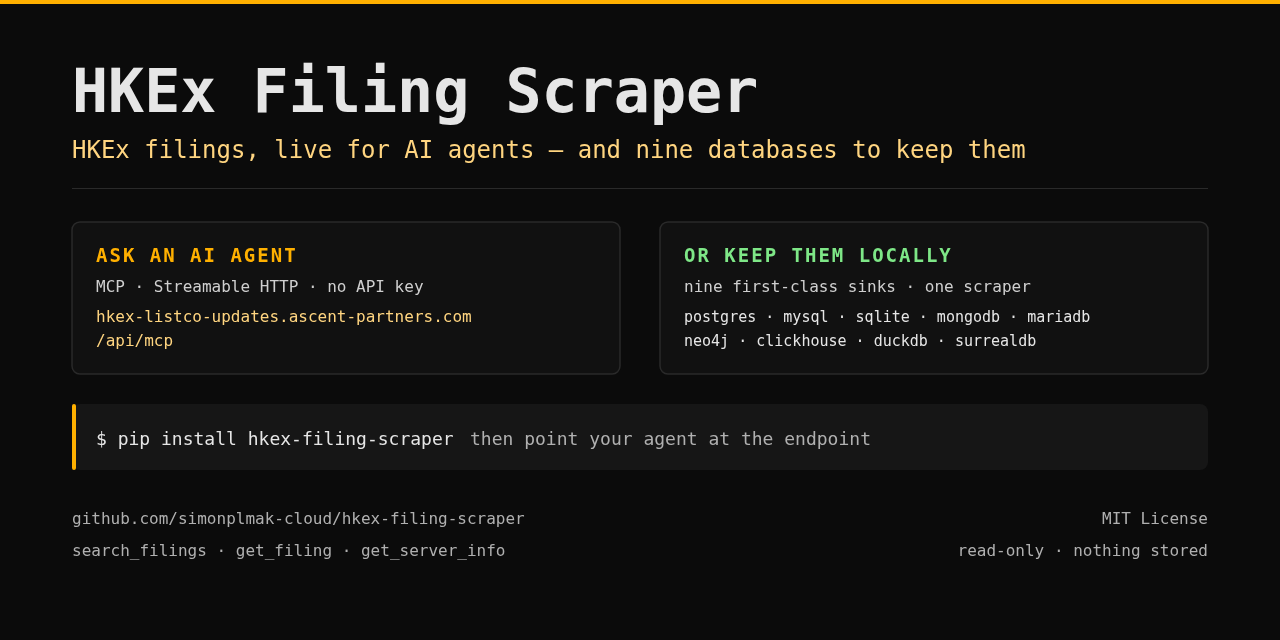
HKEx Filings
io.github.simonmak-ascent
只读的香港交易所监管公告 MCP 服务器,让助手搜索公告并提取文件正文与表格。
Mcp Confirm
io.github.les-k
一个本地 MCP 服务器,为删除文件的工具调用增加一次性确认、提示文本净化和执行前复查。