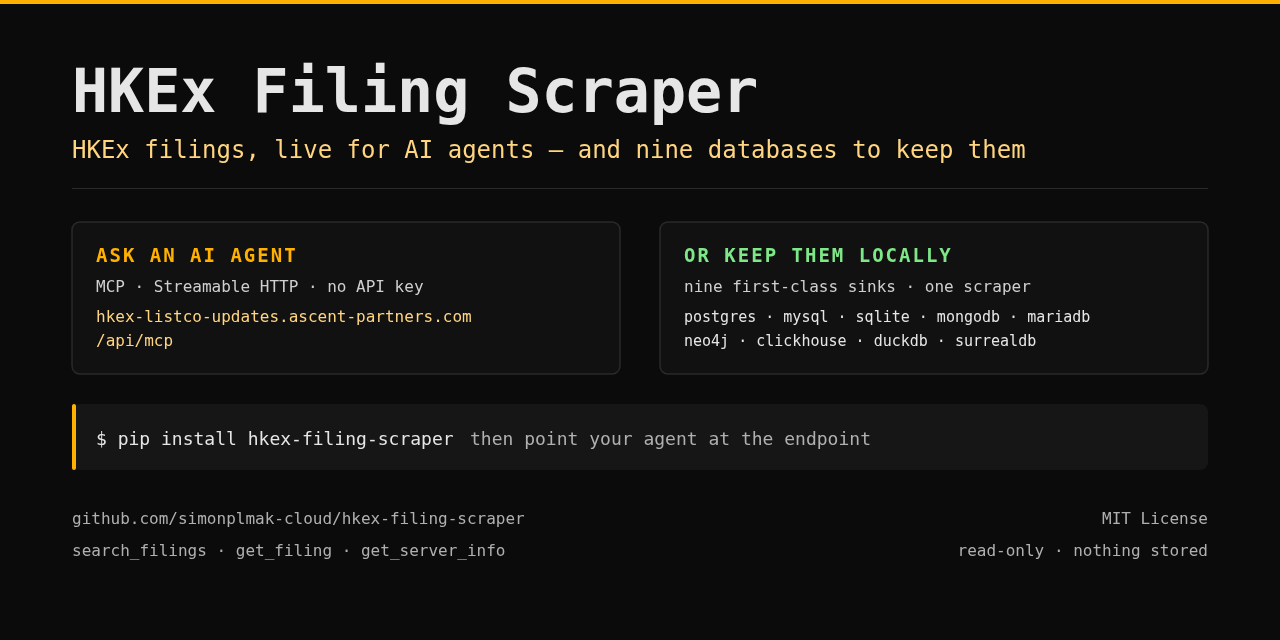
HKEx Filings
io.github.simonplmak-cloud由 GitHub 帳號 simonplmak-cloud 發布v2.4.1更新於 Oct 2, 2026
Live HKEx (Hong Kong Stock Exchange) regulatory filings for AI agents.
發布方自己的服務:SEC Filings
概覽
唯讀的 MCP 服務,串接香港交易所(HKEx)即時監管公告,讓助理搜尋、瀏覽並擷取公告內文與表格。
- 可以做什麼
- 在最多 31 天的時間範圍內搜尋公告,可依股票代碼、標題、文件類型、類別或股票名稱篩選
- 透過公告面向瀏覽某個時間範圍內包含的內容
- 下載單一公告文件並擷取其內文與表格
- 查詢閘道本身的伺服器資訊
- 本機 stdio 版本針對已儲存的語料提供更完整的工具集
- 適用情境
- 當助理需要取得目前或歷史港交所公告、中期報告等上市公司文件,用於研究、法遵查核或對本機語料做檢索,又不想自行撰寫爬蟲時適用。
- 執行需求
- 可使用託管的 Streamable HTTP 端點(無需 API 金鑰),或在本機安裝 PyPI 套件 hkex-filing-scraper(以 uvx 或 pip 執行);本機流程需設定 DATABASE_TARGET,非 SQLite 目標還需連線資訊如 POSTGRES_DSN。需要能連上港交所的網路。
安裝
在 SourceWeft 中
- 開啟 儀表板中的 HKEx Filings,將其新增到工作區。
- 為需要使用其工具的對話啟用該服務。
Web executable,透過 Streamable HTTP。 遠端服務在工作區中設定後即可從網頁執行環境執行。
交給代理程式安裝
把這段提示詞貼上到 Claude Code、Codex、Cursor 等代理程式,或 SourceWeft 對話中。代理程式會讀取該伺服器的安裝指南,先向你展示發布者、端點和登入方式,經你同意後再把它新增到你的客戶端。金鑰不會寫進任何命令。
閱讀 https://sourceweft.com/mcp/io.github.simonplmak-cloud%2Fhkex-filings/install.md,並按其中說明把這個 MCP 伺服器接入我的客戶端。修改任何設定之前,先告訴我它的發布者、端點和登入方式,等我確認。不要把 API 金鑰寫進命令或我會提交的檔案;問我金鑰應從哪裡取得。其他 MCP 客戶端
把它新增到你客戶端的 mcpServers 設定中。
{
  "mcpServers": {
    "hkex-filings": {
      "type": "http",
      "url": "https://hkex-listco-updates.ascent-partners.com/api/mcp"
    }
  }
}
README
HKEx Filing Scraper
An open-source scraper for 25+ years of HKEx regulatory filings — into any of nine databases, with full-text extraction, graph linking, and a read-only MCP server for AI agents.
[HKEx Filing Scraper — one scraper, many databases]
[CI] [MCP Registry] [Glama MCP] [GitHub Release] [PyPI] [Python 3.10+] [Docs] [MCP] [Ruff] [License: MIT]
Overview
The US has EDGAR full-text search. Japan has EDINET. Hong Kong has a search form that returns one page at a time. There is no bulk, machine-readable, full-text corpus of HKEx filings. This builds one.
An open-source Python tool that scrapes 25+ years of Hong Kong Stock Exchange (HKEx) regulatory filings and ingests them into any combination of nine databases — with full-text and table extraction, chunk-level coverage, optional graph linking, and a read-only MCP server so AI agents can query the corpus or the live site.
It speaks the undocumented HKEx JSON API directly, which is faster and more resilient than driving a browser.
Vendors & Integrations
Databases — nine first-class destinations, in documented popularity order (see the support matrix):
- PostgreSQL — production-grade open-source relational
- MySQL / MariaDB — GPL relational servers, one driver
- SQLite — zero-server file database, no install needed
- MongoDB — document database
- Neo4j — property-graph database
- ClickHouse — columnar analytics engine
- DuckDB — in-process analytical engine
- SurrealDB — multi-model graph + document database
AI clients — any MCP-capable agent; ready-made configuration for Claude, ChatGPT, Cursor, VS Code/Copilot, Gemini CLI, opencode, Manus, and Perplexity.
Available on — PyPI · Glama · MCP Registry · hosted gateway.
Two Ways to Use It
[Example: install, scrape filings into SQLite, then query the hosted MCP gateway from an AI agent]
Use the Hosted MCP Gateway
POST, Streamable HTTP, no API key:
Four read-only tools: get_server_info, search_filings (a window of at most 31 days, with
optional stock-code, title, document-type, category, and stock-name filters),
list_filing_facets (browse what a window contains), and get_filing (downloads one
document and extracts its text and tables).
[Two ways to reach HKEx filings from an AI agent: the hosted MCP gateway or the local stdio server]
Point a client at it — for example opencode:
Then ask:
Ready-made configuration for Claude, ChatGPT, Cursor, VS Code/Copilot, Gemini CLI, opencode,
Manus, and Perplexity is in AI agent support — and for a stored corpus,
the stdio MCP server exposes a wider tool catalog and is published on
Glama. The gateway is listed
in the official MCP Registry as
com.ascent-partners/hkex-filings.
Featured on Glama — the read-only stdio MCP server is also published on Glama, where Glama scans the built server and scores tool-definition quality (currently 4.7/5).
Quick Start (≤ 5 minutes)
Fastest path: no install — use the hosted gateway at
https://hkex-listco-updates.ascent-partners.com/api/mcp (Streamable HTTP), or install and run
locally:
Optional extras: excel, postgres, mysql, duckdb, mongodb, clickhouse, neo4j,
mcp, pdf, all, dev.
DATABASE_TARGET is an ordered, comma-separated list of sink ids; the order decides which
sink serves reads. To start with no server:
hkex-scraper runs the full pipeline (metadata + documents + graph); hkex-scraper --full-history covers everything since April 1999. The schema is created automatically.
Full install options and per-sink settings are in Getting started.
Database Support
Every sink is a first-class destination; rows are in documented popularity order. The full matrix — licenses, capability differences, per-engine notes — is in Database sinks.
¹ Source-available, not OSI-approved — labeled exceptions per ADR 0003.
Valid sink ids, in documented order: postgres, mysql, sqlite, mongodb, mariadb, neo4j, clickhouse, duckdb, surrealdb. Set one variable and the same run feeds every sink:
How This Compares
Four ways to get HKEx filings, and what each one costs you.
If you need licensed, redistributable, SLA-backed data, buy the feed. If you need a complete local corpus for research, compliance, or RAG, this replaces the pipeline you would otherwise write yourself.
How It Works
- Phase 1 scrapes filing metadata through a JSF session, splitting the range into monthly
chunks and deduplicating on a 16-character MD5
filingId. - Phase 2 downloads each filing's PDF/HTML/Excel document, extracts text and tables to Markdown, and writes the payload.
- Graph linking (optional) writes
has_filingandreferences_filingedges whenCOMPANY_TABLEis set. - Failure isolation — a failure on one sink is logged and counted but never blocks another; the run exits non-zero if any configured sink failed.
Deeper detail: Architecture · ADR 0002.
HKEx API session
Data model
exchange_filing and scrape_coverage are SCHEMAFULL; has_filing /
references_filing are the graph edges written by graph.py.
Sink contract and read routing
Features
- Fast API scraping — direct HKEx JSON API; no browser or Selenium.
- Full history — every filing from April 1999 to today, with chunk-level coverage checks.
- Document processing — PDF/HTML/Excel text and structured tables, extracted to Markdown.
- Multi-sink — any ordered combination of nine databases, each with native idempotent upserts.
- AI-ready — a hosted live MCP gateway plus a local stdio MCP server.
- Resumable and observable — batching, parallel downloads, stalled-job detection, per-sink
counters, and
--coverage-report/--parity-report/--verify. - Optional dependencies — the core is
requests+beautifulsoup4; drivers and document extraction are extras with graceful fallbacks.
Documentation
- Getting started · Configuration · CLI
- Database sinks (matrix) — PostgreSQL, MySQL/MariaDB, SQLite, MongoDB, Neo4j, ClickHouse, DuckDB, SurrealDB
- Live MCP gateway · AI agent support · MCP server
- Architecture · Troubleshooting · Testing
- Roadmap · De-risking register · Upgrading
- What's new · Releasing · Legal & Terms of Use · Changelog
- Docs site: https://hkex-listco-updates.ascent-partners.com/ · Try it locally (
examples/)
Development
Tests are pure unit tests; SQLite and DuckDB contract tests run in-process, and integration tests that need a server are skipped unless that sink is configured. See Testing.
CI and deployment run through the APG workbench pipeline.
The deploy smoke check probes the public hostname through the balancer, not a local port.
Contributing
See CONTRIBUTING.md; report security issues per SECURITY.md. Ideas and questions are welcome in Discussions.
Built by Ascent Partners.
If this saves you time, a ⭐ on GitHub helps others find it.
Use with Context7
Up-to-date HKEx Filing Scraper documentation is indexed on Context7, so coding agents can pull it into context on demand. With the Context7 MCP server or ctx7 CLI installed, name the library in your prompt:
License
MIT — see LICENSE. That covers this project's code only; optional dependencies
carry their own licenses, notably the pdf extra (PyMuPDF / pymupdf4llm), which is
AGPL-3.0 and deliberately excluded from .[all]. See
docs/legal.md.
Data & Terms of Use: this is a research tool for the undocumented HKEx JSON API, and it is not affiliated with or endorsed by HKEx. Commercial redistribution of HKEx data may require a licensed HKEx feed; see docs/legal.md.
來源:README.md,提交 75b7d61
工具
0版本歷史
2- v2.4.1最新Oct 1, 2026
- v2.4.0Sep 20, 2026
評分
已滿足適用檢查項的 50%
該評分衡量此收錄條目的完整程度,依據註冊中心條目、端點與公開來源計算得出。它不是對伺服器本身的評價,也不表示伺服器安全或目前可用:可連通性是帶日期的檢查結果,評分也不包含安裝量或使用者評價。
- 近 30 天內可連通必需25 分
請保持端點能夠回應 MCP 握手;SourceWeft 每 30 天探測一次。
- 已宣告認證方式必需10 分
請在註冊中心條目中宣告憑證請求標頭,或保持端點能夠回應探測,以便判定其認證方式。
- 已列出工具15 分
請讓伺服器在無憑證時回應 tools/list,或發布可在沙箱中無憑證啟動的軟體包。
- 描述必需15 分
- 圖示10 分
- 文件15 分
- 授權條款10 分
其他 Filings 整合

SEC Filings
tools.filings官方發布者
讀取公開的 SEC EDGAR 申報文件、已揭露的 XBRL 財務資料與抽樣申報比較,並保留來源連結與 accession 編號。

SEC filings
由 GitHub 帳號 ladanyin 發布
遠端 MCP 伺服器,讓助理取得美國公司最新 10-K、10-Q 或 8-K 的摘錄,以及最新全年營收或淨利。

getfilings: the Filings door
由 GitHub 帳號 allooloo 發布
遠端 MCP 路由服務,依日期區間回傳發行人的已簽章、附回執的監理申報與公告,並提供發行人查詢與市場節點清單。

US SEC EDGAR Filings, FDIC Bank Solvency & EPA/OSHA
由 GitHub 帳號 jesleytassili-glitch 發布
分析SEC EDGAR的10-K/8-K/Form 4檔案、FDIC銀行償付能力比率、EPA ECHO與OSHA違規記錄。AI 翻譯

SEV — Company Discovery from SEC Filings
由 GitHub 帳號 ETSquareAI 發布
本機 MCP 伺服器,把研究問題轉成依相關度排序的公司,並附上經核實的 SEC 10-K/10-Q 段落與財務資料。