HKEx Filings
io.github.simonmak-ascentv2.4.1Updated Oct 2, 2026
Live HKEx (Hong Kong Stock Exchange) regulatory filings for AI agents.
Overview
Read-only MCP server for Hong Kong Stock Exchange regulatory filings, letting an assistant search filings and extract document text and tables.
- What it does
- Exposes four read-only tools: get_server_info, search_filings (a window of at most 31 days with optional stock-code, title, document-type, category and stock-name filters), list_filing_facets to browse what a window contains, and get_filing to download one document and extract its text and tables. The same project also ships a local pipeline that scrapes 25+ years of HKEx filings into one or more of nine databases, with the stdio MCP server exposing a wider tool catalog over a stored corpus.
- When to use it
- Useful when an assistant needs current HKEx regulatory filings, such as summarising interim reports or tracking announcements for a stock code. Also relevant for building a local research, compliance or RAG corpus of filings since April 1999 instead of writing a scraper yourself.
- Requirements
- The stdio server runs as a local process via uvx from the PyPI package hkex-filing-scraper; the local pipeline needs Python plus pip install and a DATABASE_TARGET setting (for example sqlite with SQLITE_PATH). A hosted remote gateway is also offered with no API key. No authentication, environment variables or headers are declared in the manifest.
Installation
In SourceWeft
- Open HKEx Filings in the dashboard and add it to a workspace.
- Enable the server for the chats that should use its tools.
Desktop only via STDIO. STDIO servers start a local process, so they need the SourceWeft desktop host.
Other MCP clients
Follow the launch instructions in the repository.
README
HKEx Filing Scraper
[HKEx Filing Scraper — one scraper, many databases]
[CI] [GitHub Release] [PyPI] [License: MIT] [Python 3.10+] [Docs] [MCP] [Glama MCP] [Ruff]
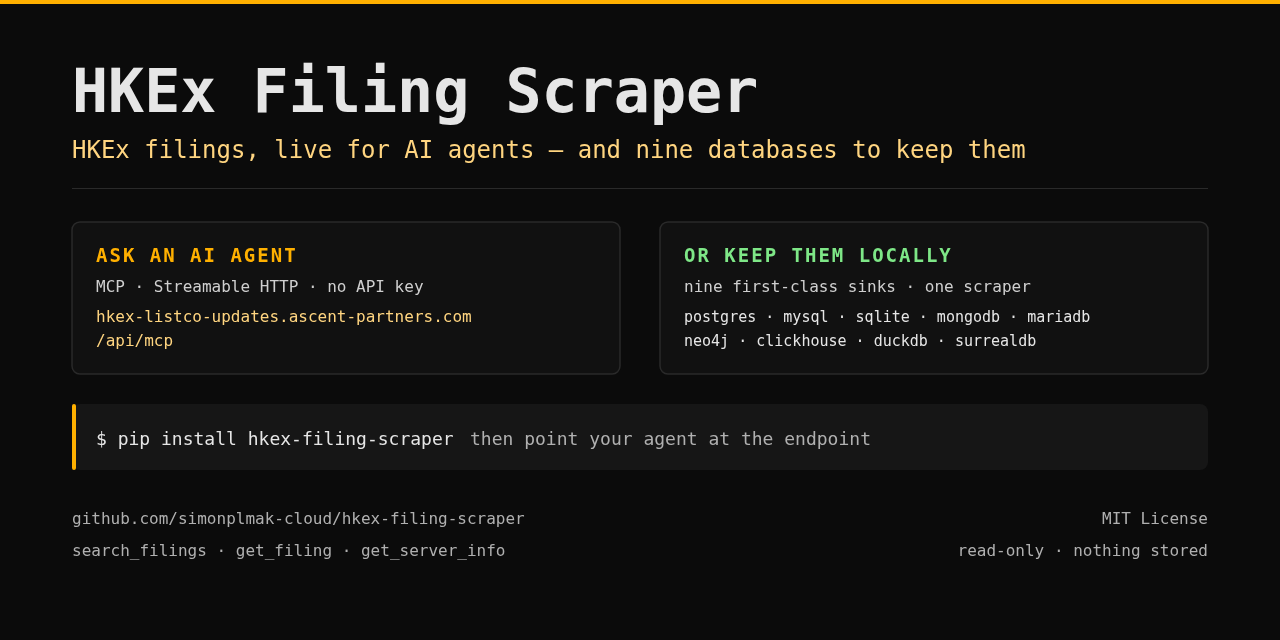
An open-source scraper for 25+ years of HKEx regulatory filings — into any of nine databases, with full-text extraction, graph linking, and a read-only MCP server for AI agents.
The US has EDGAR full-text search. Japan has EDINET. Hong Kong has a search form that returns one page at a time. There is no bulk, machine-readable, full-text corpus of HKEx filings. This builds one.
An open-source Python tool that scrapes 25+ years of Hong Kong Stock Exchange (HKEx) regulatory filings and ingests them into any combination of nine databases — with full-text and table extraction, chunk-level coverage, optional graph linking, and a read-only MCP server so AI agents can query the corpus or the live site.
It speaks the undocumented HKEx JSON API directly, which is faster and more resilient than driving a browser.
Vendors & Integrations
Databases — nine first-class destinations, in documented popularity order (see the support matrix):
- PostgreSQL — production-grade open-source relational
- MySQL / MariaDB — GPL relational servers, one driver
- SQLite — zero-server file database, no install needed
- MongoDB — document database
- Neo4j — property-graph database
- ClickHouse — columnar analytics engine
- DuckDB — in-process analytical engine
- SurrealDB — multi-model graph + document database
AI clients — any MCP-capable agent; ready-made configuration for Claude, ChatGPT, Cursor, VS Code/Copilot, Gemini CLI, opencode, Manus, and Perplexity.
Available on — PyPI · Glama · MCP Registry · hosted gateway.
Two Ways to Use It
[Example: install, scrape filings into SQLite, then query the hosted MCP gateway from an AI agent]
Use the Hosted MCP Gateway
POST, Streamable HTTP, no API key:
Four read-only tools: get_server_info, search_filings (a window of at most 31 days, with
optional stock-code, title, document-type, category, and stock-name filters),
list_filing_facets (browse what a window contains), and get_filing (downloads one
document and extracts its text and tables).
[Two ways to reach HKEx filings from an AI agent: the hosted MCP gateway or the local stdio server]
Point a client at it — for example opencode:
Then ask:
Ready-made configuration for Claude, ChatGPT, Cursor, VS Code/Copilot, Gemini CLI, opencode,
Manus, and Perplexity is in AI agent support — and for a stored corpus,
the stdio MCP server exposes a wider tool catalog and is published on
Glama. The gateway is listed
in the official MCP Registry as
io.github.simonmak-ascent/hkex-filings.
Featured on Glama — the read-only stdio MCP server is also published on Glama, where Glama scans the built server and scores tool-definition quality (currently 4.7/5).
Quick Start (Local)
Optional extras: excel, postgres, mysql, duckdb, mongodb, clickhouse, neo4j,
mcp, pdf, all, dev.
DATABASE_TARGET is an ordered, comma-separated list of sink ids; the order decides which
sink serves reads. To start with no server:
hkex-scraper runs the full pipeline (metadata + documents + graph); hkex-scraper --full-history covers everything since April 1999. The schema is created automatically.
Full install options and per-sink settings are in Getting started.
Database Support
Every sink is a first-class destination; rows are in documented popularity order. The full matrix — licenses, capability differences, per-engine notes — is in Database sinks.
¹ Source-available, not OSI-approved — labeled exceptions per ADR 0003.
Valid sink ids, in documented order: postgres, mysql, sqlite, mongodb, mariadb, neo4j, clickhouse, duckdb, surrealdb. Set one variable and the same run feeds every sink:
How This Compares
Four ways to get HKEx filings, and what each one costs you.
If you need licensed, redistributable, SLA-backed data, buy the feed. If you need a complete local corpus for research, compliance, or RAG, this replaces the pipeline you would otherwise write yourself.
How It Works
- Phase 1 scrapes filing metadata through a JSF session, splitting the range into monthly
chunks and deduplicating on a 16-character MD5
filingId. - Phase 2 downloads each filing's PDF/HTML/Excel document, extracts text and tables to Markdown, and writes the payload.
- Graph linking (optional) writes
has_filingandreferences_filingedges whenCOMPANY_TABLEis set. - Failure isolation — a failure on one sink is logged and counted but never blocks another; the run exits non-zero if any configured sink failed.
Deeper detail: Architecture · ADR 0002.
Features
- Fast API scraping — direct HKEx JSON API; no browser or Selenium.
- Full history — every filing from April 1999 to today, with chunk-level coverage checks.
- Document processing — PDF/HTML/Excel text and structured tables, extracted to Markdown.
- Multi-sink — any ordered combination of nine databases, each with native idempotent upserts.
- AI-ready — a hosted live MCP gateway plus a local stdio MCP server.
- Resumable and observable — batching, parallel downloads, stalled-job detection, per-sink
counters, and
--coverage-report/--parity-report/--verify. - Optional dependencies — the core is
requests+beautifulsoup4; drivers and document extraction are extras with graceful fallbacks.
Documentation
- Getting started · Configuration · CLI
- Database sinks (matrix) — PostgreSQL, MySQL/MariaDB, SQLite, MongoDB, Neo4j, ClickHouse, DuckDB, SurrealDB
- Live MCP gateway · AI agent support · MCP server
- Architecture · Troubleshooting · Testing
- Roadmap · De-risking register · Upgrading
- What's new · Releasing · Legal & Terms of Use · Changelog
- Docs site: https://hkex-listco-updates.ascent-partners.com/ · Try it locally (
examples/)
Development
Tests are pure unit tests; SQLite and DuckDB contract tests run in-process, and integration tests that need a server are skipped unless that sink is configured. See Testing.
Contributing
See CONTRIBUTING.md; report security issues per SECURITY.md. Ideas and questions are welcome in Discussions.
Built by Ascent Partners.
If this saves you time, a ⭐ on GitHub helps others find it.
Use with Context7
Up-to-date HKEx Filing Scraper documentation is indexed on Context7, so coding agents can pull it into context on demand. With the Context7 MCP server or ctx7 CLI installed, name the library in your prompt:
License
MIT — see LICENSE. That covers this project's code only; optional dependencies
carry their own licenses, notably the pdf extra (PyMuPDF / pymupdf4llm), which is
AGPL-3.0 and deliberately excluded from .[all]. See
docs/legal.md.
Data & Terms of Use: this is a research tool for the undocumented HKEx JSON API, and it is not affiliated with or endorsed by HKEx. Commercial redistribution of HKEx data may require a licensed HKEx feed; see docs/legal.md.
Source: README.md at commit ce6aed0
Tools
0Version history
1- v2.4.1LatestOct 2, 2026
More servers like HKEx Filings
Startup Valuation MCP Server
io.github.simonmak-ascent
Lets an assistant compute startup valuations using 80+ pre-revenue and industry-specific formulas through 14 MCP tools.

Intangible Asset Valuation MCP Server
io.github.simonmak-ascent
Lets an assistant compute intangible asset valuations such as IP, technology, goodwill, purchase price allocation and impairment using 124+ textbook formulas.

Snappfood & SnappMarket
io.github.sepehr071
Read-only search and price comparison for Snappfood restaurants and SnappMarket groceries in Iran, including delivery fees and flash deals.