
Intangible Asset Valuation MCP Server
io.github.simonmak-ascentv2.1.1Updated Oct 2, 2026
Intangible asset valuation: 14 tools, 124+ formulas for IP, technology, goodwill, PPA, impairment.
Overview
Lets an assistant compute intangible asset valuations such as IP, technology, goodwill, purchase price allocation and impairment using 124+ textbook formulas.
- What it does
- Exposes 14 folded tools covering time value, discount rates, cost, market and income approaches, intellectual property, technology, customer and human capital assets, goodwill and purchase price allocation, impairment, royalty analysis, uncertainty methods and transfer pricing. Each tool takes a method argument and returns a structured result with value, assumptions, steps and a formula reference. Three guided prompts and a machine-readable method catalog are also provided.
- When to use it
- Useful when an assistant must produce auditable valuation calculations for ASC 805, IFRS 3, ASC 350 or IAS 36 style workflows, or when a user wants patent, trademark, technology, customer relationship or goodwill figures computed from stated assumptions rather than estimated freehand.
- Requirements
- Runs as a local stdio process from the PyPI package intangible-valuation, started with uvx or after installing the mcp extra; Python is required. A hosted Streamable HTTP endpoint is also described. No authentication, API keys or environment variables are declared.
Installation
In SourceWeft
- Open Intangible Asset Valuation MCP Server in the dashboard and add it to a workspace.
- Enable the server for the chats that should use its tools.
Desktop only via STDIO. STDIO servers start a local process, so they need the SourceWeft desktop host.
Other MCP clients
Follow the launch instructions in the repository.
README
Intangible Asset Valuation Engine
A complete intangible asset valuation library implementing 124+ functions from the Intangible Asset Valuation textbook — Python library, MCP server, and AI-agent skills.
[CI] [PyPI] [License: MIT] [Python 3.11+] [Coverage] [Docs] [MCP tools] [OpenSSF Scorecard] [Glama MCP]
Overview
A production-grade Python library for intangible asset valuation, implementing every formula from the Intangible Asset Valuation textbook by Simon Mak, William Yuen, Paul Wu, and Wayne Hu (Valuation in Practice Series, Ascent Partners). Designed for developers, financial analysts, accountants, and AI agents who need auditable, structured valuation computations for ASC 805 / IFRS 3 compliant workflows.
Three-layer architecture:
- Python Library — 22 modules, 124+ typed functions, all returning
ValuationResult(value + assumptions + steps + formula reference) - MCP Server — 14 folded tools (124+ formulas) for AI agents via stdio and hosted Streamable HTTP
- AI-agent skills — 4 skill definitions with workflow guidance for valuation domains
Installation
Quick Start
Python Library
MCP Server (for AI Agents)
The server exposes 14 tools, each folding a family of formulas behind a
method argument — time value, discount rates, cost/market/income approaches,
IP, technology, customer and human-capital assets, goodwill and purchase price
allocation, impairment, royalty analysis, uncertainty (Monte Carlo / decision
trees), and transfer-pricing / litigation.
Local (stdio):
Hosted (Streamable HTTP) — no install, no API key:
OpenCode — add to opencode.json:
Claude Desktop / Cursor — add the HTTP URL
https://intangible-valuation.simonmak.com/api/mcp as an MCP server, or run the
stdio entrypoint above.
MCP Registry & Glama — published as
io.github.simonmak-ascent/intangible-valuation. The
server.json manifest declares both the hosted
streamable-http remote and a PyPI stdio package, and
glama.json carries the Glama listing. Install and run the stdio
server from either registry:
Listed on Glama and the Official MCP Registry.
Prompts and resources. Besides the 14 tools, the server offers three guided
prompts (purchase_price_allocation, value_ip_asset, impairment_test) and a
machine-readable method catalog at intangible-valuation://methods, so agents can
see every method's required parameters before calling a tool.
AI-agent skills
Copy the skills/ directory to your agent's skills folder:
asset-valuation— Patents, trademarks, technology, customer relationships, human capitaldiscount-rate-construction— Build-up, CAPM, WACC, risk premiums, adjustmentspurchase-price-allocation— ASC 805 / IFRS 3 PPA workflow, goodwill calculationimpairment-testing— ASC 350, IAS 36 goodwill and intangible impairment
Valuation Methods by Category
Why This Library?
- Auditable — Every function returns
ValuationResultwith value, method, formula reference, assumptions, and step-by-step calculation breakdown - Textbook-accurate — All 124+ formulas verified against book example values with 1056 unit tests
- AI-ready — MCP server (14 folded tools) and Skills for seamless AI agent integration
- Complete coverage — All three valuation approaches (cost, market, income) across 19 chapters
- Open source — MIT license, extensible, well-documented
Development
Documentation
- API Reference: intangible-valuation.simonmak.com
- PyPI: pypi.org/project/intangible-valuation
- MCP Server Guide: docs/mcp.md
- AI Skills Guide: docs/skills.md
Companion Textbook
Intangible Asset Valuation: A Comprehensive Guide to Valuing Brands, IP, Technology, and Human Capital
Theory, Methods, Regulation, and Practice — Valuation in Practice Series by Ascent Partners
By Simon Mak, William Yuen, Paul Wu, Wayne Hu · 176 pages · 19 chapters · 3 appendices
Citing This Project
Based on formulas from the Intangible Asset Valuation textbook.
Use with Context7
Up-to-date Intangible Asset Valuation Engine documentation is indexed on Context7, so coding agents can pull it into context on demand. With the Context7 MCP server or ctx7 CLI installed, name the library in your prompt:
License
MIT — see LICENSE.
By Ascent Partners — part of the Valuation in Practice Series.
If this saves you time, a ⭐ on GitHub helps others find it.
Source: README.md at commit 6a26bd9
Tools
0Version history
1- v2.1.1LatestOct 2, 2026
More servers like Intangible Asset Valuation MCP Server
Startup Valuation MCP Server
io.github.simonmak-ascent
Lets an assistant compute startup valuations using 80+ pre-revenue and industry-specific formulas through 14 MCP tools.

maidr
io.github.xability
Lets an assistant draw accessible maidr charts in a conversation and move a blind or low-vision reader through them by sound, braille and screen reader.
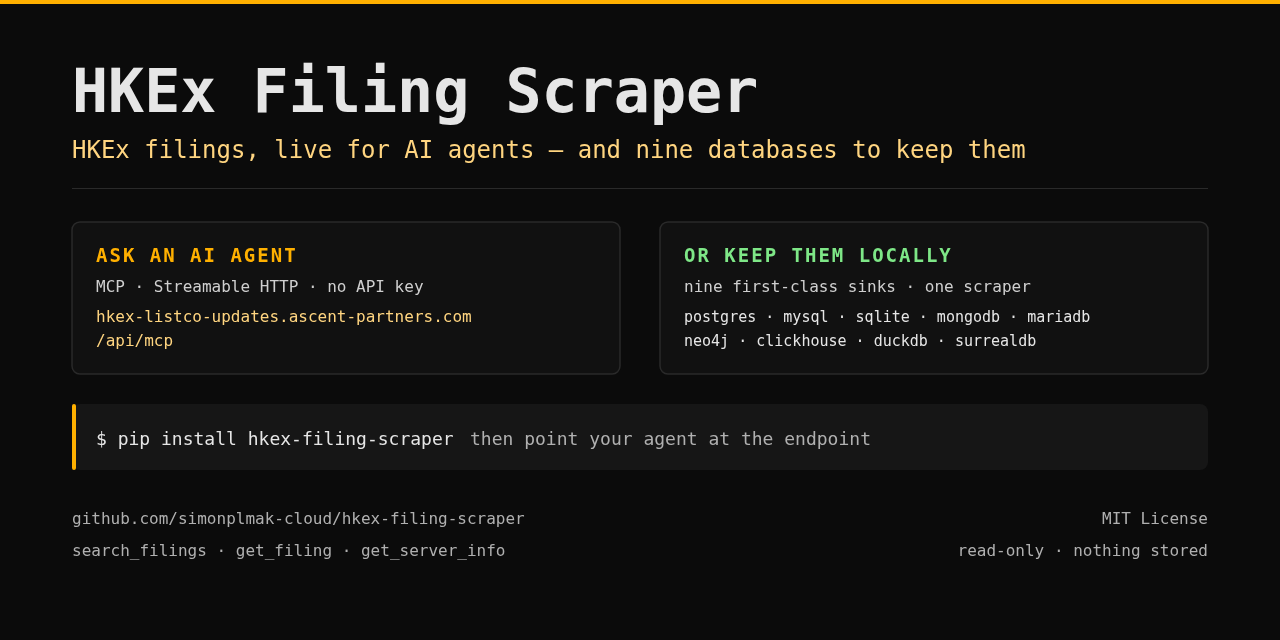
HKEx Filings
io.github.simonmak-ascent
Read-only MCP server for Hong Kong Stock Exchange regulatory filings, letting an assistant search filings and extract document text and tables.